
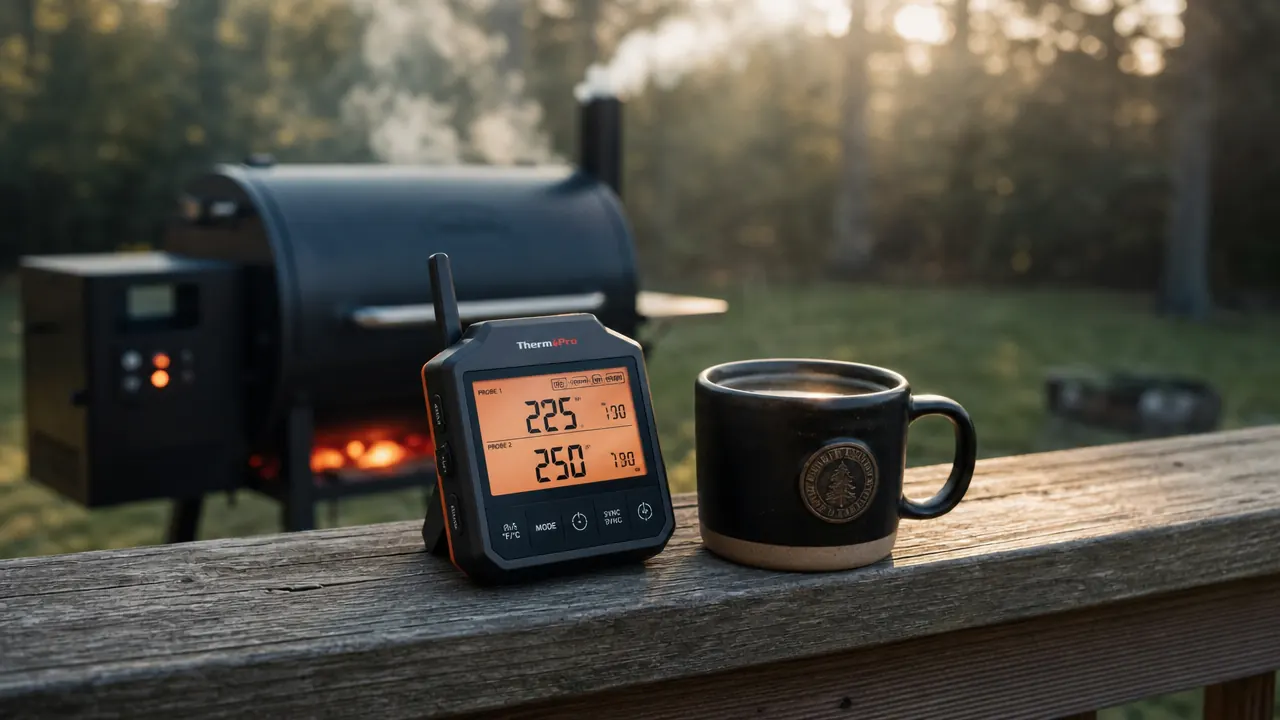
We have gone through three cheap meat thermometers in five years. The first one failed mid-brisket when the probe wire cracked at the collar. The second read low by about eight degrees and we only figured that out after serving undercooked chicken thighs to the whole family. The third had a display that fogged up inside the first month. When we finally tried the Govee Bluetooth Meat Thermometer with dual probes, the bar was admittedly not set high. Twelve months later and roughly 40 cooks in, we have a clear picture of where this thing earns its keep and where it cuts corners.
The Govee comes with two stainless steel probes, a compact transmitter unit that clips onto the grill, and a Bluetooth connection that pairs to the Govee Home app on your phone. Street price puts it in the budget range. For that money, we expected it to be fine. What we did not expect was to still be using it a year later without once reaching for a backup.
The Quick Verdict
Accurate enough for backyard BBQ, genuinely useful dual-probe setup, and priced so low the cons are easy to forgive. Bluetooth range is the one real limitation.
Amazon Check Today's Price →If you are losing heat every time you lift the lid to check temps, this is the fix.
The Govee dual-probe setup lets you monitor two cuts at once from your phone without opening the grill once. Check today's price on Amazon.
Amazon Check Today's Price on Amazon →How We Have Used It Over the Past 12 Months
We use a Z Grills pellet smoker as our primary rig, so the Govee thermometer lives next to the grill about six months out of the year. The other six months it gets called up for oven roasts, a couple of turkey cooks on a kettle charcoal grill, and one memorable overnight pork shoulder that ran 14 hours while we slept.
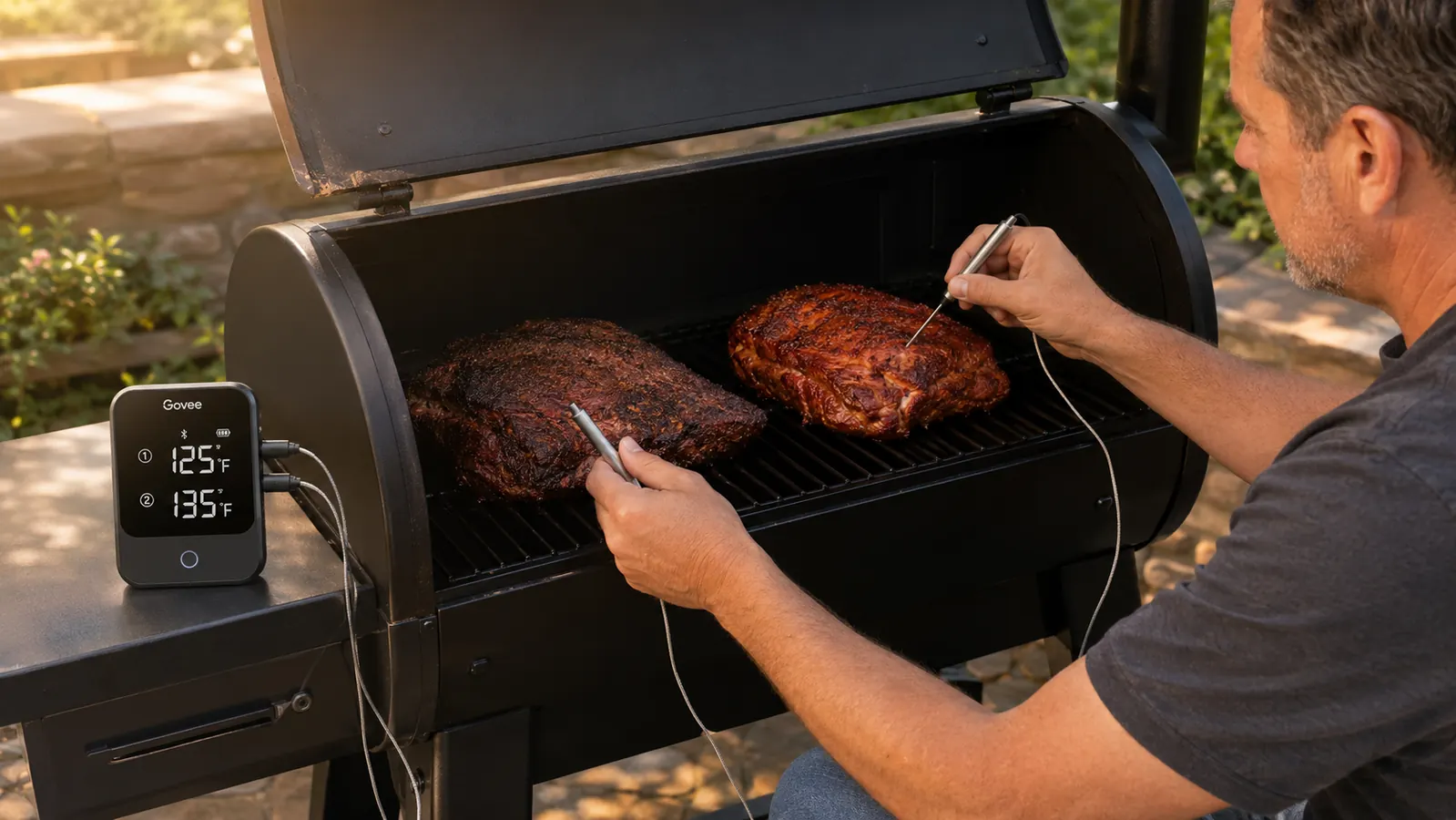
Our standard setup: probe one goes into the thickest part of the main cut, probe two monitors grill ambient temperature when we want to cross-check the pellet smoker's built-in readout. We sync the transmitter to our phone before the cook starts and leave the phone in the house. The app sends push notifications when we hit our target temp or when temp moves outside a set range. That is the core use case, and it works reliably.
Over the year we cooked pork shoulder roughly once a month, ribs six or seven times, whole chickens on the rotisserie three times, a spatchcocked turkey at Thanksgiving, and that one 15-pound brisket for a neighborhood cookout in August. The Govee probes went into almost every one of those cooks. The only times we skipped it were when we were just grilling burgers or steaks fast over direct heat, where the cook is too short for wireless monitoring to add much.
Accuracy: How Close Does It Actually Read?
We calibrated both probes against a ThermoWorks instant-read in boiling water and in an ice bath at the start. Probe one read 212.4 degrees in the boil, probe two read 211.8 degrees. Ice bath gave us 32.6 and 32.2 respectively. Both probes are within about a degree across the full range we tested. For low-and-slow BBQ where you are targeting 195 to 205 for pulled pork or 200 to 210 for brisket, that margin is negligible.
During actual long cooks we spot-checked the Govee readout against the ThermoWorks Dot at the stall and near the finish line. The Govee consistently read within 2 to 3 degrees of the reference probe, and the gap narrowed at higher temps. For ambient grill temperature readings, accuracy was slightly looser, running about 4 to 5 degrees lower than the built-in grill probe. We factor that in and treat it as directional rather than precise when using it for ambient monitoring.
For an affordable thermometer with two probes, hitting within 2 to 3 degrees on a 14-hour brisket cook is honestly better than we expected.
Bluetooth Range: The One Thing That Trips You Up
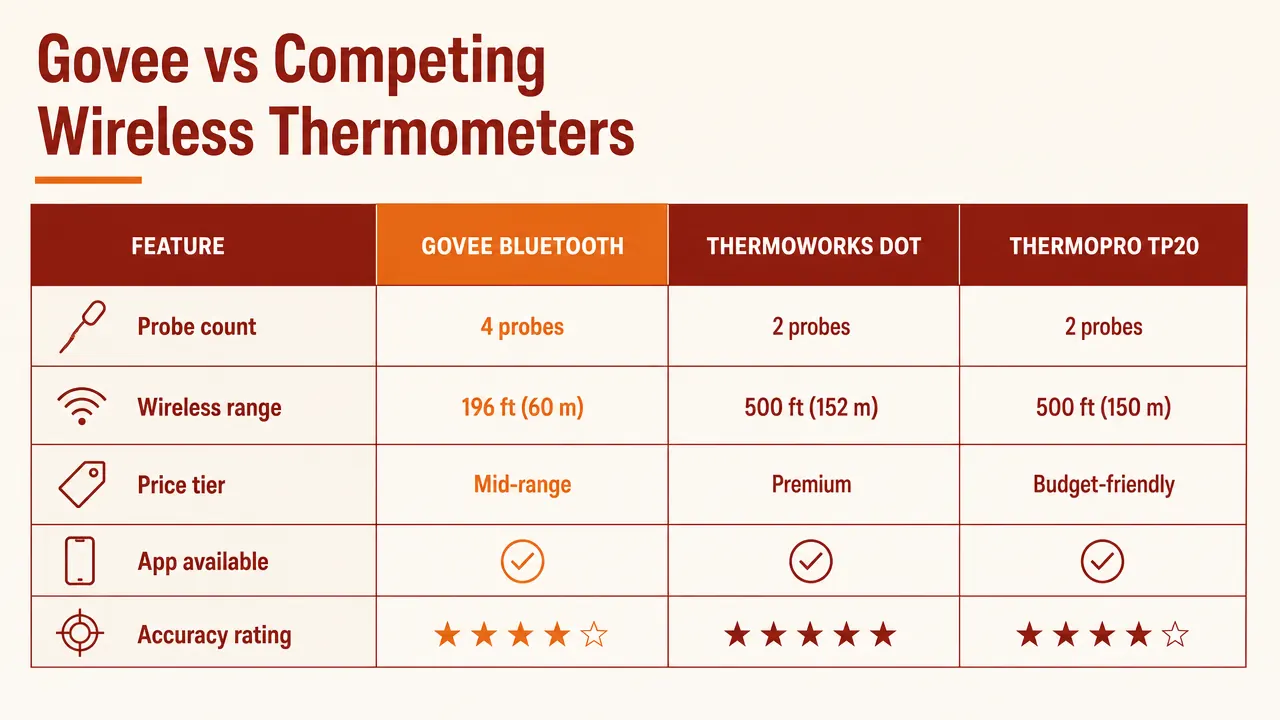
Govee advertises up to 230 feet of Bluetooth range. In real backyard conditions that number means almost nothing. Our setup has the smoker in the back corner of the yard, roughly 40 feet from the back door of the house, with one exterior wall in between. At that distance, the app stays connected about 80 percent of the time. Moving further into the house, say to the kitchen on the other side or upstairs, drops that connection to maybe 50 percent.
What that means in practice: if you walk to the far end of the house, you will occasionally miss an alert because the phone lost the signal for a few minutes before reconnecting. This happened three times during the overnight pork shoulder cook. None of them were critical misses because the meat was deep in the stall and temp was not changing fast, but it is worth knowing before you decide to sleep through a 14-hour cook relying solely on this thermometer.
If your grill is close to the house and you stay within two rooms, Bluetooth holds solid. If you have a large yard or plan to monitor from inside a thick-walled house, you will want to look at Wi-Fi enabled thermometers or a model with a dedicated physical display you can check at a glance. We cover that comparison in our Govee vs ThermoWorks Dot breakdown.
The App: Genuinely Good for a Budget Thermometer
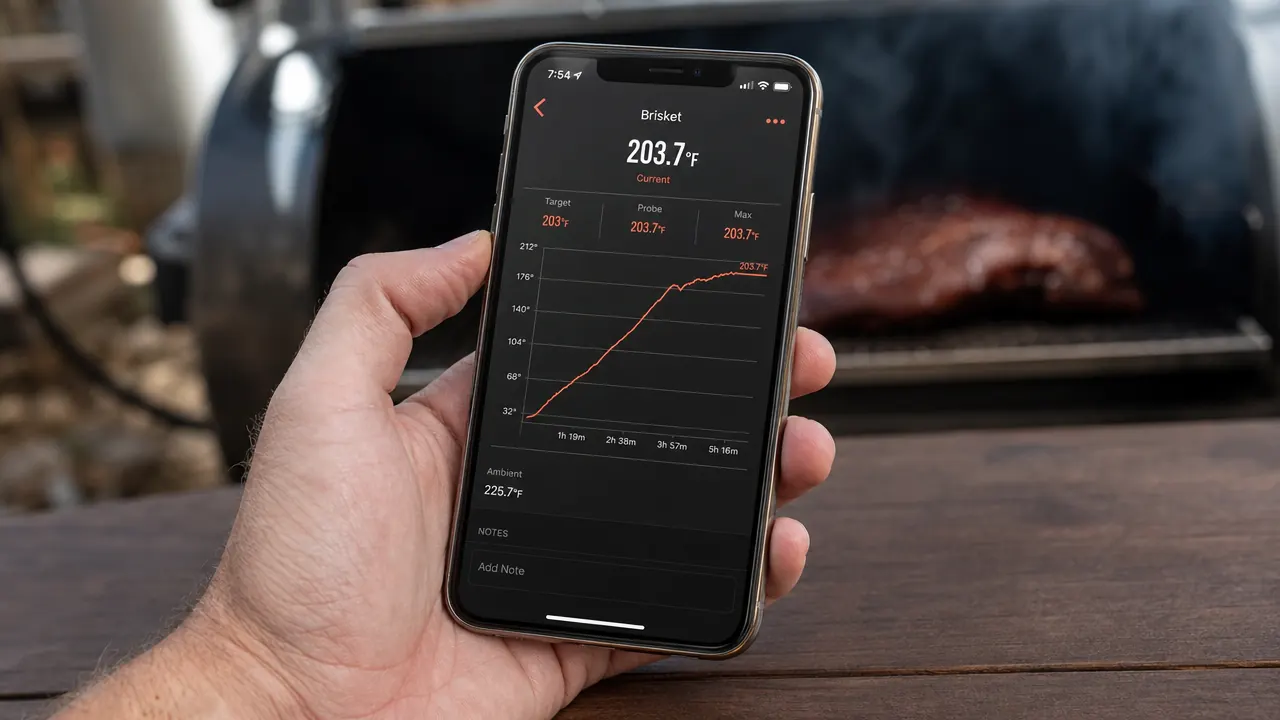
The Govee Home app is free, requires a brief account setup, and works on both Android and iOS. Once the thermometer is paired, the app shows real-time temperature for both probes, a configurable high and low alarm for each, and a graph of temperature history over the cook. The graph view turned out to be more useful than we expected. During a long cook, watching the temperature curve through the stall, then the climb, then the plateau at finish temp gives you a clear read on how the cook is progressing without opening the grill once.
Alarm customization is solid. For a pork shoulder we set probe one to alert at 165 for the wrap and again at 200 for the pull. Probe two we set with a low alarm at 225 so we know if the smoker drops below target. The app lets you name each probe, which is a small thing that matters when you have two cuts going and need to know which reading belongs to which.
On the downside, the app has occasional sync hiccups where it shows an old temperature reading for 30 to 60 seconds before refreshing. It has never cost us anything, but it is mildly annoying when you are watching for that final push to pull temp. The app also requires Bluetooth to stay active on your phone, which can affect battery life on a full-day cook. We kept the phone plugged in during the 14-hour brisket session specifically for that reason.
Probe and Build Quality After 12 Months
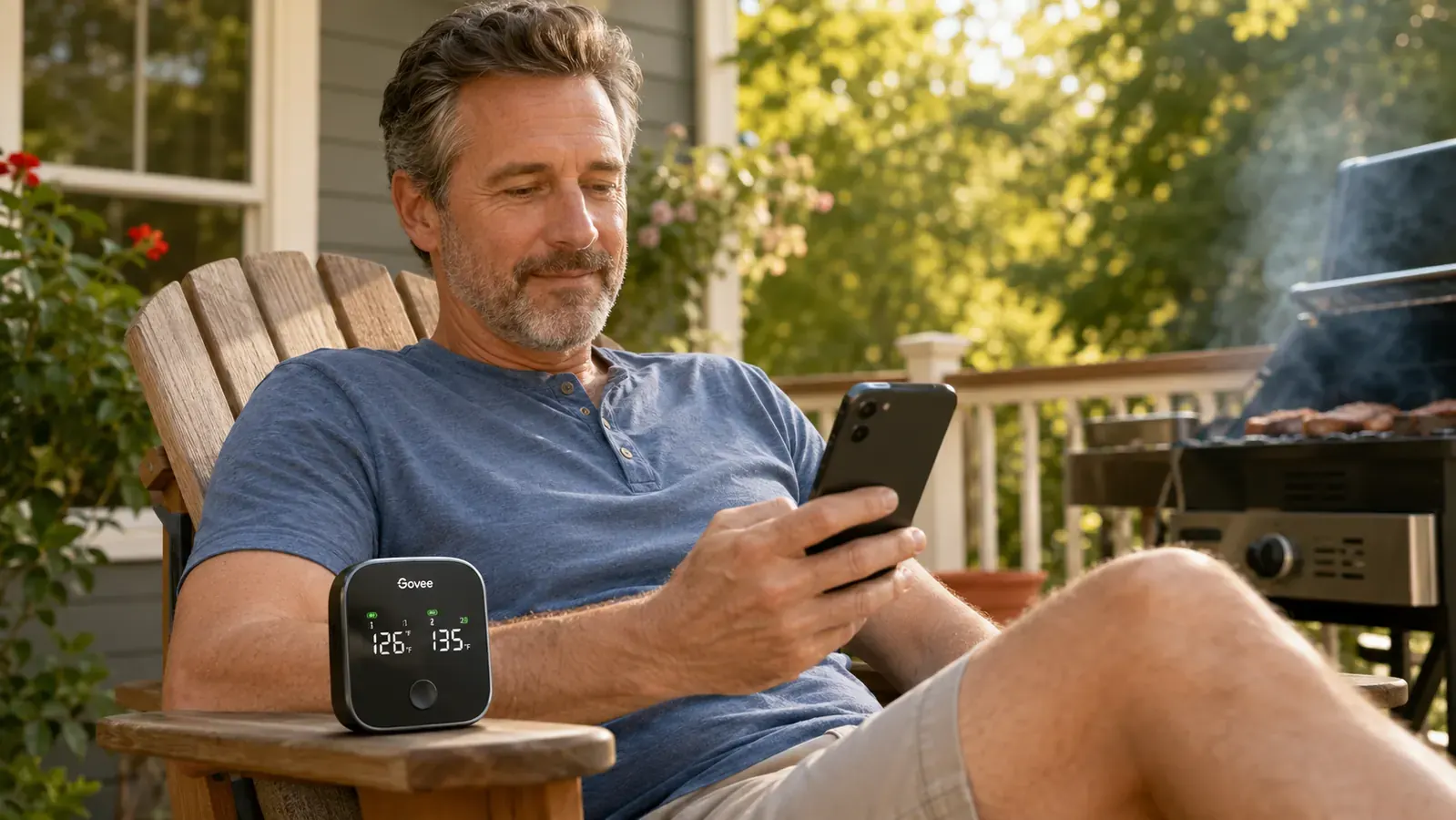
The probes are stainless steel with a braided heat-resistant cable running to the transmitter. After a year of use, both probes look largely the same as when we pulled them out of the box. The cable on probe one has a slight kink near the collar from being pinched by a grill lid once, but it reads accurately and has not frayed. The connector ends that plug into the transmitter still seat firmly with no wiggle.
The transmitter unit is plastic with a clip on the back for attaching to the grill. Ours has some light heat discoloration on the bottom face from sitting close to a hot grill surface during one cook, but it is functionally fine. The display on the transmitter itself shows temperature for both probes in large digits, which is a useful backup when you are standing at the grill and do not want to pull out your phone.
The probes are rated to 572 degrees Fahrenheit. The cables are rated to 482 degrees. We have stayed well within those limits on every cook. If you are doing high-heat searing or direct-flame work, these are not the probes you leave in the meat during that phase.
What We'd Do Differently With It
After a year we have a few habits that make the Govee work better than our first few cooks with it. First, always check Bluetooth signal before starting a long cook. Walk from the grill to wherever you plan to be during the cook and confirm the app shows a live reading. If you lose connection standing in your kitchen, reposition the transmitter on the grill before you start. A few extra feet of cable slack between the grill clip and the meat probe makes it easier to angle the transmitter toward the house.
Second, use the second probe for ambient grill temperature on cooks over four hours. Even if your grill has a built-in probe, it is reading temperature at dome level, which runs hotter than grate level where your meat actually sits. The Govee probe at grate height gives a more honest reading of what the meat is actually experiencing. For those 10 and 12-hour cooks, that difference matters.
Third, do not store the probes coiled tight. The braided cable is heat-resistant but not infinitely flexible. We hang ours on a small hook in the grill cabinet. Small thing, but the probes still look new after a year.
What I Liked
- Accuracy within 2 to 3 degrees across the full low-and-slow temp range
- Two probes at this price is genuinely rare and actually useful
- App is clean, alarms are easy to configure, temperature graph is a real feature
- Physical transmitter display works as a backup when you are standing at the grill
- Probe and cable construction held up through a full year of regular use
Where It Falls Short
- Bluetooth range is inconsistent beyond 40 to 50 feet with walls in the way
- App occasionally shows stale readings for 30 to 60 seconds during reconnects
- Cable rating of 482 degrees limits use in high-heat or direct-flame scenarios
- Transmitter clip is plastic and shows heat discoloration if placed too close to the grill surface
- No Wi-Fi option means you cannot monitor from a different building or farther parts of a large property
Who This Is For
The Govee Bluetooth Meat Thermometer is built for the weekend pitmaster who wants to stop hovering over the grill and start monitoring from the yard, the porch, or the living room couch. If you do long low-and-slow cooks, smoke multiple cuts at once, or just want to stop opening the lid every 30 minutes to poke at the meat with an instant-read, this setup delivers real value at a price that makes it a no-brainer buy. It is also a strong entry point if you have never used a leave-in thermometer and want to learn what the numbers actually look like across a full cook before spending more on a premium unit. For more on whether wireless thermometers are worth it in general, check our guide on 10 ways a wireless thermometer upgrades every cook.
Who Should Skip It
If your grill is more than 60 feet from where you plan to spend the cook, or if you have a large house with multiple thick interior walls between you and the backyard, Bluetooth range will frustrate you. The same goes if you want to monitor a cook from a different floor, a garage, or a detached space. For those situations, a Wi-Fi enabled thermometer or a unit with a dedicated receiver display that you carry with you will serve you better. This is also not the right tool for high-heat applications like searing, where probe temps would exceed the cable rating. For an honest comparison at the next price point up, see our Govee vs ThermoWorks Dot write-up.
A year of use and we would buy it again at this price.
Two probes, a clean app, and accuracy that holds up on full-day smokes. The Govee Bluetooth Meat Thermometer punches well above its weight for backyard BBQ. Check today's price on Amazon before it changes.
Amazon Check Today's Price on Amazon →