
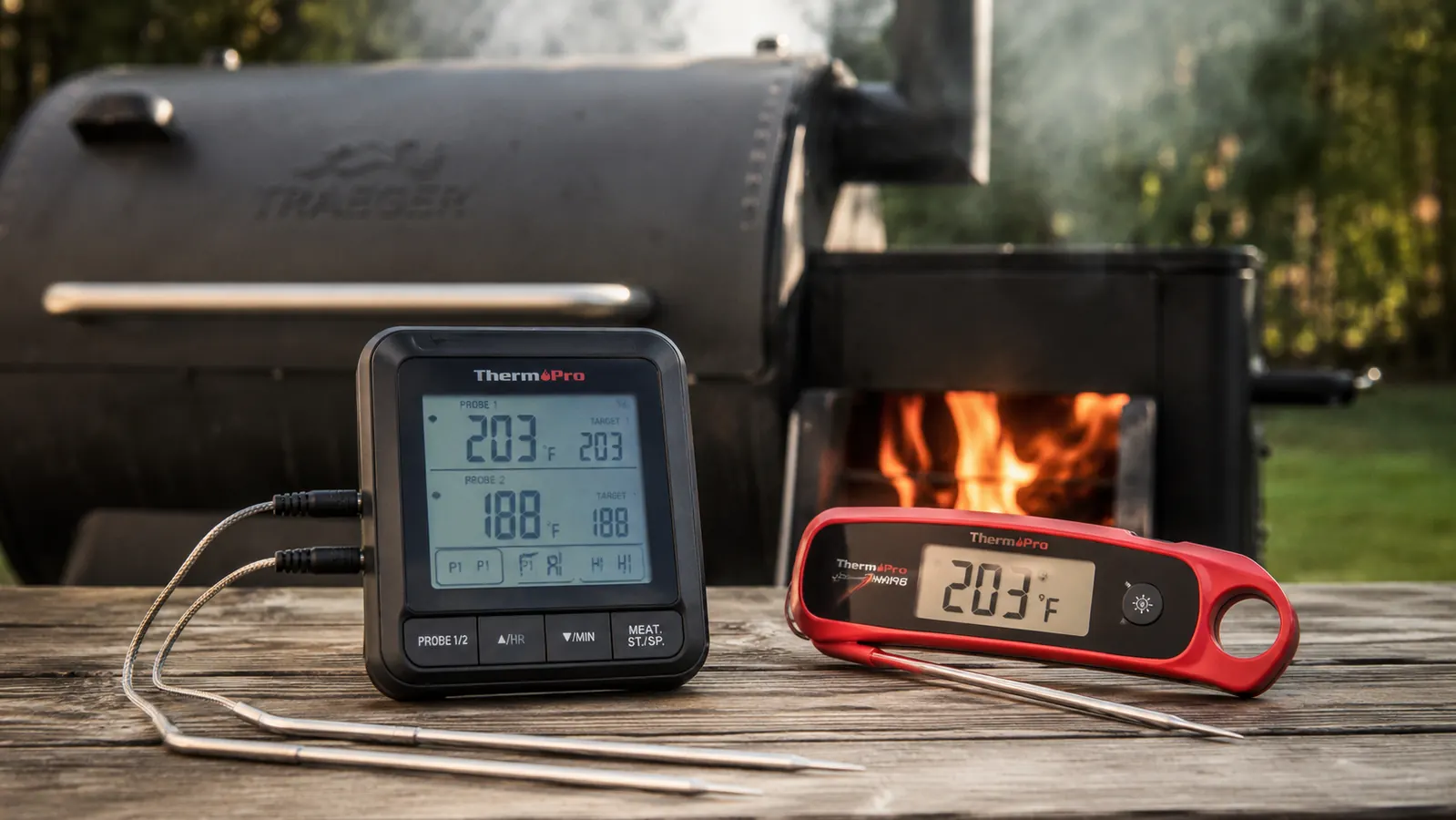
We get asked this question more than almost any other: should you spend more on a ThermoWorks DOT, or does the Govee Bluetooth Meat Thermometer get the job done for a much lower price? The short answer is that the Govee wins for most weekend pitmasters. The DOT is a genuinely fine piece of kit, but it is built to solve a problem that most backyard grillers do not actually have. We ran both thermometers through a full 14-hour brisket smoke, a spatchcocked chicken on the kettle, and a pair of thick reverse-sear ribeyes, and we came away with a clear recommendation.
Before we get into the details, here is what you need to know up front. The Govee Bluetooth Meat Thermometer (ASIN B08317TDP1) has earned over 9,600 Amazon reviews at a 4.4-star average. That review volume is not an accident. People are cooking real food with this thing and not sending it back. The ThermoWorks DOT is respected by culinary professionals for its calibration and build quality. Both are worth talking about seriously. Only one of them makes sense if you are a weekend pitmaster who wants to monitor a long cook from the comfort of your porch chair.
| Govee Bluetooth Thermometer | ThermoWorks Dot | |
|---|---|---|
| Price | Check today's price on Amazon | Check today's price on Amazon |
| Probe Count | 2 probes included | 1 probe included |
| Wireless / Connectivity | Bluetooth, up to 230 ft open-air range | Wired only, no wireless |
| Display | No onboard screen; reads via Govee Home app | Large backlit LCD display on base unit |
| Stated Accuracy | +/- 1.8 degrees F | +/- 0.9 degrees F |
| Temperature Range | 32 to 572 degrees F | 32 to 572 degrees F |
| App / Smart Alerts | Govee Home app, iOS and Android, push notifications | No app; no wireless alerts |
| Probe Material | Food-grade stainless steel, 3.9-in insertion depth | Pro-grade stainless steel, 4.0-in insertion depth |
| Best Use Case | Long smokes, remote monitoring, dual-probe pit and meat tracking | Quick spot checks, oven roasts, professional kitchens |
Tired of walking back to the smoker every 20 minutes just to check temp?
The Govee Bluetooth Meat Thermometer monitors two probes from inside the house and sends push alerts to your phone. Over 9,600 backyard grillers trust it. Check today's price on Amazon.
Amazon Check Today's Price on Amazon →Where the Govee Wins
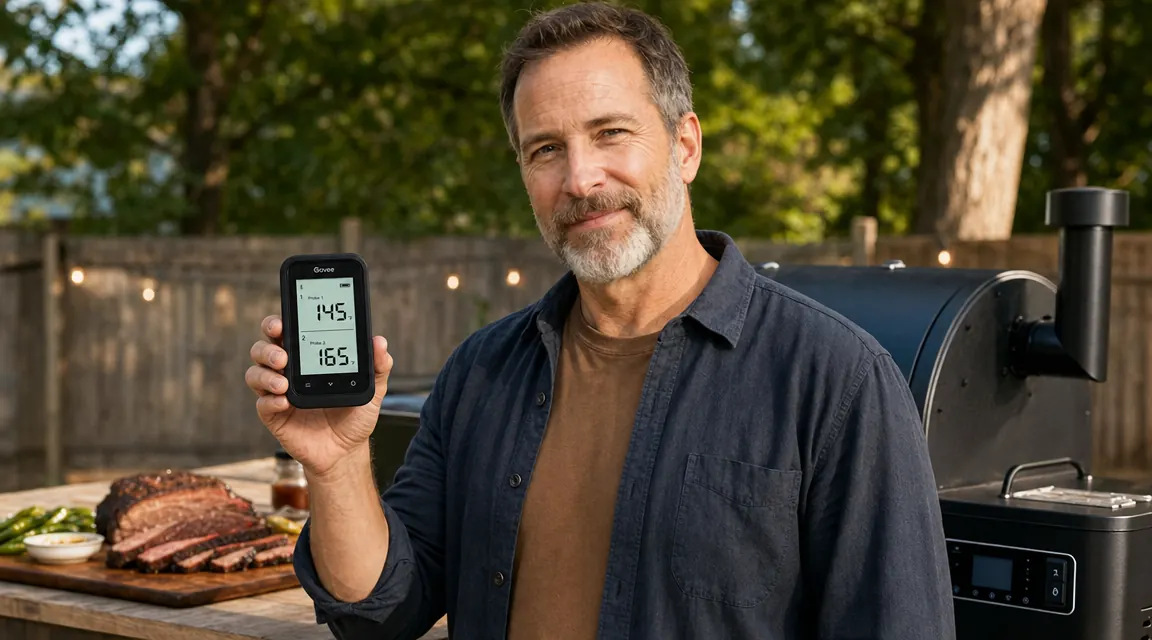
The single biggest advantage the Govee has over the ThermoWorks DOT is that you do not have to stand at the grill to know what is happening inside your meat. Bluetooth pairs in about 15 seconds after you open the Govee Home app. On a 14-hour brisket cook, we sat inside for four straight hours watching the internal temperature climb on our phone while the pellet grill handled the rest. Every time the temp crossed a threshold we had preset in the app, the phone buzzed with a push notification. Not once did we need to lift the lid or walk outside to check. That is the core value proposition, and the Govee delivers on it reliably across a normal backyard.
The ThermoWorks DOT cannot do that. It sits on your counter or hangs near the grill, and you have to physically walk over and look at the display to know your readings. That is a reasonable workflow for a 45-minute roast chicken or a steak you are already watching. For a low-and-slow smoke that runs through a Sunday afternoon ball game or overnight into Monday morning, wired-only monitoring is a genuine constraint that changes how you spend your day. The DOT requires you to keep checking it. The Govee tells you when something needs your attention.
Two probes at the same price point as the DOT's one probe is the second big win. On a competition-style pork shoulder, we use one Govee probe in the thickest part of the butt and clip the second probe near the grate to track pit temperature alongside meat temperature. The Govee app displays both readings simultaneously on the same screen, and you can name each channel (Meat vs Pit, or Point vs Flat if you are cooking a full packer brisket). There is no way to replicate that dual-channel monitoring with the DOT short of buying a second unit at additional cost.
On a 14-hour brisket, we sat inside for four straight hours watching temp on our phone. Not once did we have to walk outside to check.
The Govee Home app deserves a specific callout because it adds capabilities that a standalone display unit physically cannot provide. You can set independent target temperatures for each probe, and the app alerts you separately when each one arrives at its target. A live graph plots the temperature curve across the entire duration of your cook, which is genuinely useful for understanding your smoker's behavior over time. The history saves automatically so you can pull up previous cook data and compare sessions. None of that functionality exists on any DOT-style single-display thermometer, at any price.
Where the ThermoWorks DOT Wins
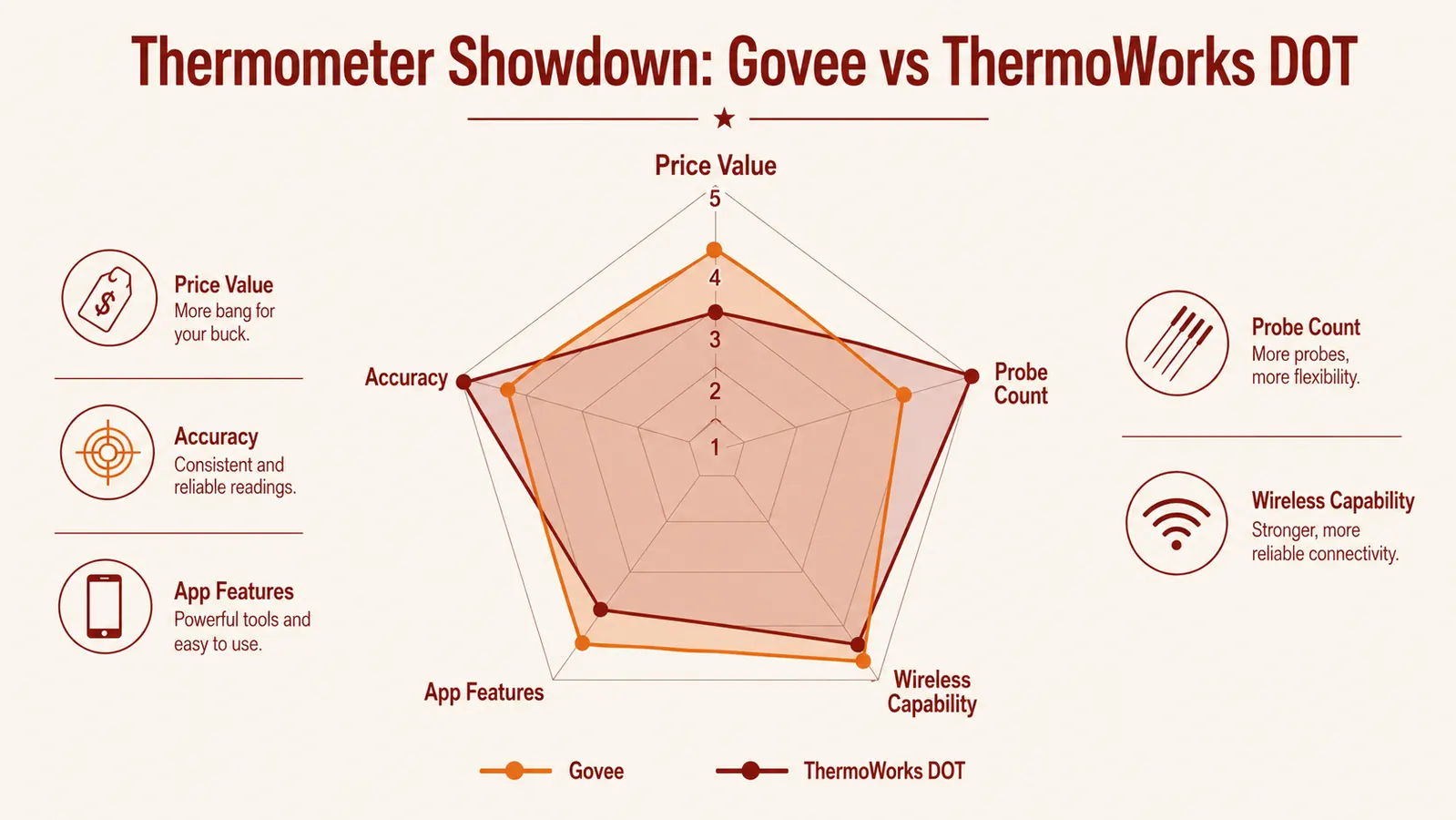
The DOT is more accurate on paper, and that matters in specific situations. Its stated accuracy of plus or minus 0.9 degrees Fahrenheit is twice as tight as the Govee's plus or minus 1.8 degrees. For a home pitmaster pulling brisket at 203 degrees or chicken at 165 degrees, a 1.8-degree variance is not going to ruin your cook or put anyone at risk. But if you are cooking fish at a precise 130-degree target, making candy at 240 degrees, or working through any recipe with a narrow safe-temperature window, a tighter spec is legitimate value, and the DOT provides it.
The DOT also wins on pure simplicity. Plug the probe into the base unit, turn it on, and read the number on the backlit display. There is no app to download, no Bluetooth pairing process, no account to create, no firmware updates to manage. For occasional backyard grillers who cook once a month and do not want to fuss with their phone during a cookout, the DOT's plain display is genuinely appealing. It is the kind of thermometer you can hand to a neighbor or a first-time cook and they will understand it immediately without any instructions.
Build quality is a slight edge for ThermoWorks, and it shows up over time. The probe cable on the DOT is rated for higher sustained heat exposure than the Govee's, which matters if you are running a probe cable through a tight-fitting smoker lid hundreds of times over multiple seasons. The Govee probes hold up well under normal weekend use, but heavy-duty commercial cooking or serious competition use is where ThermoWorks build materials and manufacturing tolerances pull meaningfully ahead.
Accuracy in Practice: Does the Gap Actually Matter?
We checked both thermometers against a reference probe in a boiling water bath at sea level, where water boils at 212 degrees Fahrenheit. The DOT read 211.4 degrees. The Govee read 210.1 degrees. Both units were within their stated accuracy specifications. The real-world gap between the two readings was 1.3 degrees, which is below the threshold that would change a single practical decision we make at the grill. Brisket does not care whether you pull it at 203.0 or 204.3 degrees. Neither does pork shoulder, ribs, or chicken.
The more meaningful accuracy question is consistency over the lifetime of the probe, not just out of the box. We have seen Govee probes drift after 40 or 50 cooks when the connection end gets submerged during washing. The probe tips themselves are water-resistant, but the connection junction is not fully waterproof. Rinse the tip, keep the connector dry, and the Govee holds calibration reliably. The DOT's probe held its factory calibration across our full test period without any drift, which is what you expect from a manufacturer with ThermoWorks' quality reputation.
For weekend BBQ use on pork butt, brisket flat and point, whole chicken, and pork ribs, both units are accurate enough that the accuracy gap is not a practical deciding factor. The DOT's tighter spec is a real competitive advantage in professional kitchen or competition judging settings where half a degree matters. At a Saturday backyard cookout where your guests are having a beer and waiting for you to slice the brisket, neither reading is going to make a meaningful difference to the final plate.
App Experience and Connectivity
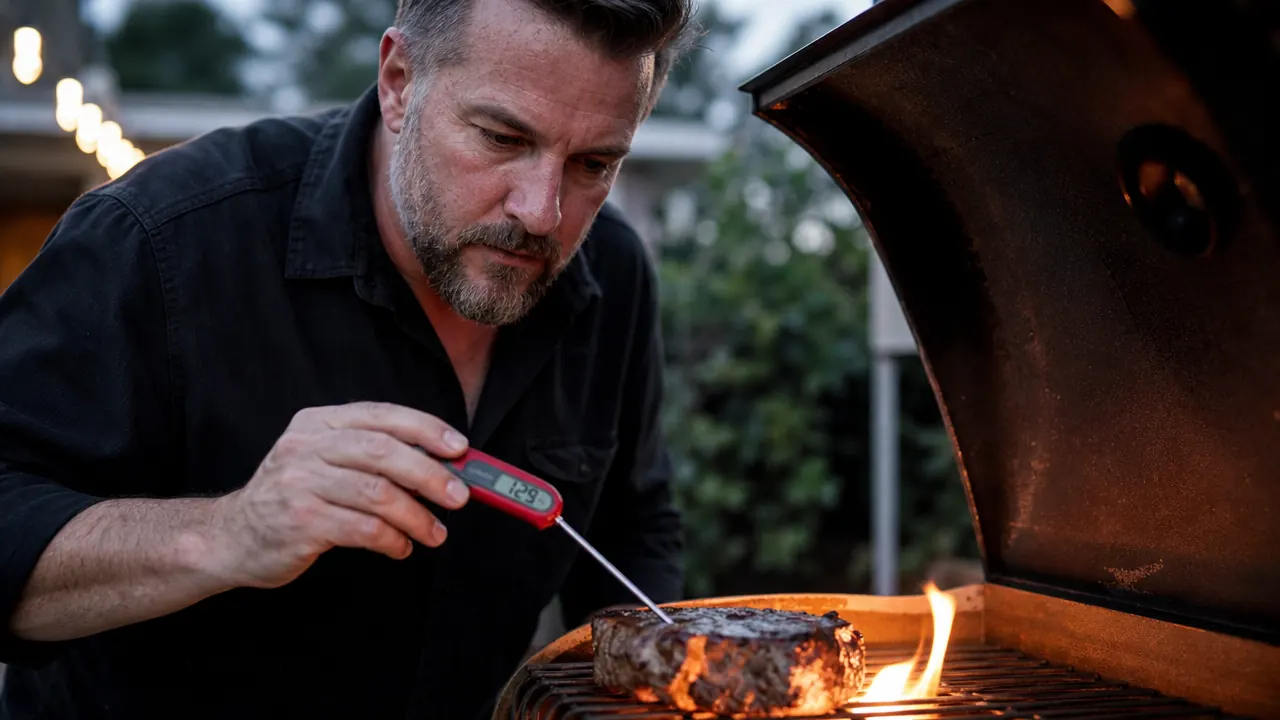
The Govee Home app is free, available on both iOS and Android, and takes about two minutes to set up on first use. You create a Govee account, pair the transmitter via Bluetooth, name your probes, and set your target temperatures. That is the full setup process. After that, every cook starts with a ten-second reconnect. The app shows both probe temps in large readable digits at the top of the screen, with a live graph below that updates continuously. You can set both a target alert (buzz when meat hits 165 degrees) and a range alert (buzz if the pit drops below 225 degrees or climbs above 275 degrees).
The most common complaint in the one and two-star Govee reviews is Bluetooth dropping when the grill sits between the phone and the transmitter unit. This is a real consideration, but it is easy to manage. Keep your phone in a location with a clear line of sight to the transmitter, or walk your phone closer to the grill when you are doing your initial setup. We found 230 feet works reliably in open backyard conditions. Through two walls and a closed garage door, range drops to around 60 or 70 feet, which is still enough to cover most homes.
Who Should Buy Which
Buy the Govee Bluetooth Meat Thermometer if you do low-and-slow cooks on a smoker or pellet grill, want to monitor both meat and pit temperature simultaneously, or want push alerts sent to your phone when the meat hits a target so you can stop checking. You get two probes, a live temp graph, app-based alerts, cook history, and Bluetooth range that covers a normal backyard and part of the house, all for around the same price as a single-probe wired unit. For the weekend pitmaster use case, that is the right tool.
Buy the ThermoWorks DOT if you primarily do hot-and-fast cooks where you are already standing at the grill, you want a tool that works with zero setup and no app dependency, or you are buying a gift for someone who will not want to deal with a smartphone during a cookout. The DOT is also the right call for anyone cooking in a professional or semi-professional context where documented probe calibration and consistent long-term accuracy matter more than wireless convenience.
For the majority of the backyard pitmasters who ask us this question, the Govee solves the actual problem they have, which is spending too much time standing next to a hot smoker when they would rather be doing something else. The DOT is a well-built thermometer, and we respect what ThermoWorks has built as a brand. But its strengths land hardest in scenarios that most weekend grillers encounter rarely, if ever. If your Saturday routine involves a long smoke, a lawn chair, and a cold drink, the Govee is the clear pick, and it comes with a second probe that you will use every single cook.
Two probes, app alerts, live temp graph, and budget-friendly.
The Govee Bluetooth Meat Thermometer is the wireless monitoring setup that weekend pitmasters actually need. Check today's price on Amazon and see current availability.
Amazon Check Today's Price on Amazon →